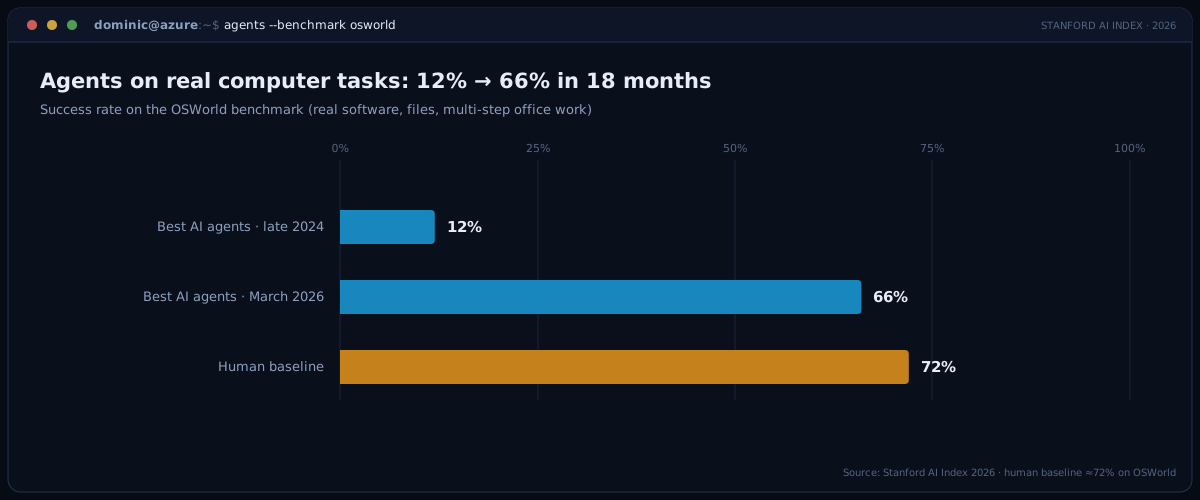
Eighteen months ago, AI agents failed 88 percent of the real-world computer tasks researchers put in front of them - navigating actual software, handling files, finishing multi-step office work. As of March 2026, the best models complete those same benchmark tasks about 66 percent of the time, within six percentage points of human performance, according to Stanford’s 2026 AI Index. Almost nothing in computing moves that fast, and it is why autonomous AI agents became the working topic of 2026: the thing your CIO, your regulator, and - as of last November - your security team all have opinions about.
I have spent twenty-five years automating infrastructure, which makes me constitutionally suspicious of the word “autonomous.” So this post is a sober map rather than a pitch: what an AI agent actually is, why 2026 specifically is the inflection point, five uses you can verify today, the risks that deserve more attention than they get, and what to do about all of it - whether you write code, run a team, or are simply wondering what this means for your career.
What an autonomous AI agent actually is
A chatbot answers. An agent acts.
More precisely: an autonomous AI agent is a system that accepts a goal rather than a message, then runs a loop - plan, act through tools, observe the result, adjust - until the goal is met, blocked, or handed back to a human. The “tools” part is what changed everything. Modern agents call APIs, run code, query databases, drive a browser, and operate other software. The generative AI model underneath is the same family of technology behind ChatGPT or Claude; what is new is the scaffolding around it, which the industry now calls an agentic workflow.
| Chatbot | Autonomous agent | |
|---|---|---|
| Input | A message | A goal |
| Output | A reply | Actions, then a result |
| Steps | One exchange at a time | Plans and executes many |
| Tools | Rarely | APIs, code, browsers, files |
| Failure mode | A wrong answer | A wrong action |
That last row is the whole subject in miniature. A wrong answer wastes your time. A wrong action deletes a file, sends an email, moves money, or approves a claim. Every serious question about agents - security, regulation, employment, liability - follows from that one asymmetry.
Why 2026, specifically
Three curves crossed.
Capability. The research nonprofit METR tracks the length of software task an agent can complete at 50 percent reliability, and found it has doubled roughly every seven months since 2019. Tasks measured in minutes gave way to tasks measured in hours; frontier labs and banks alike now talk openly about agents that run for hours at a stretch.
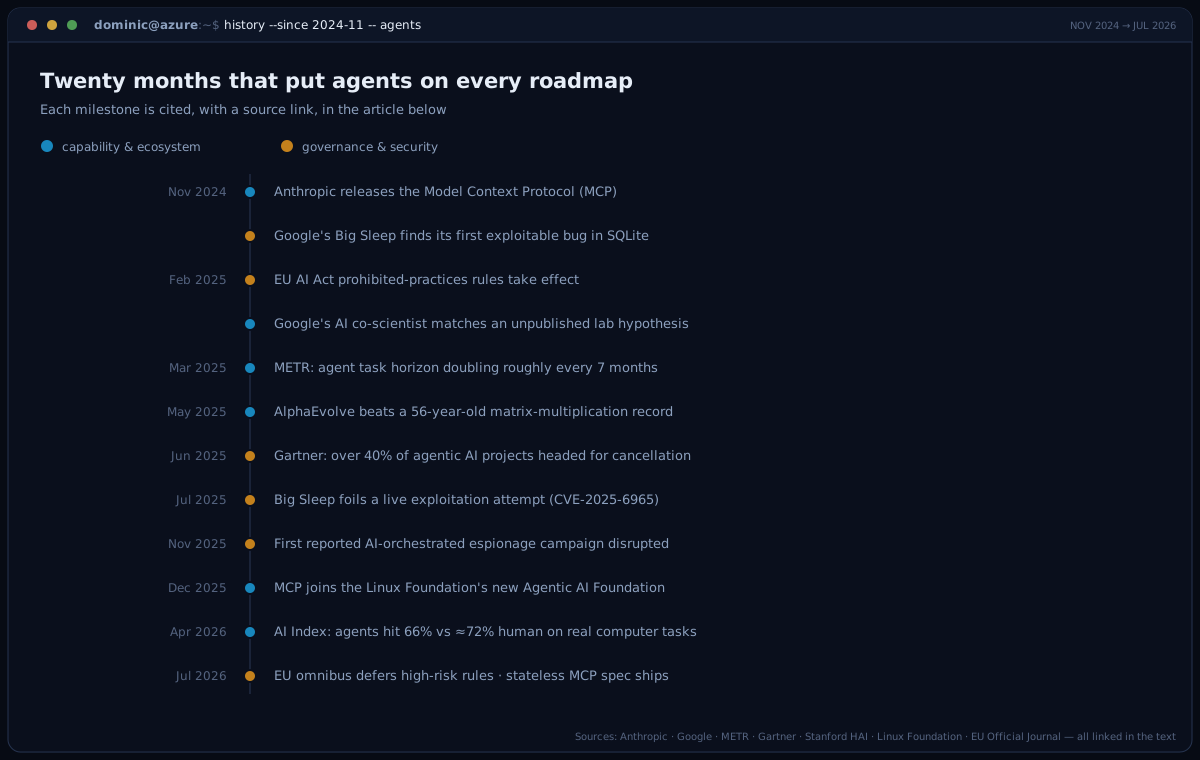
Plumbing. In November 2024 Anthropic released the Model Context Protocol (MCP), an open standard best described as USB-C for AI tools: one connector between agents and the systems they act on. OpenAI, Google, and Microsoft adopted it during 2025, it moved under the Linux Foundation’s new Agentic AI Foundation in December, and the July 2026 revision of the spec targets exactly the unglamorous things - statelessness, enterprise scale - that mark a technology leaving its demo phase. Standardized plumbing is what turned intelligent automation from bespoke integration work into an ecosystem.
Product and money. Gartner projected last August that 40 percent of enterprise applications would embed task-specific agents by the end of 2026, up from under 5 percent in 2025. JPMorgan told CNBC in June it plans to deploy agents that work autonomously for far longer than today’s versions. And yet the same Stanford AI Index that documented the capability jump found actual agent deployment still in the single digits across nearly every business function, while Gartner itself predicts that over 40 percent of agentic AI projects will be cancelled by the end of 2027 - mostly for escalating costs and unclear business value, not model failure.
Hold those facts together and you have 2026 in one sentence: the technology crossed the usefulness threshold, and organizations are discovering that the model was never the hard part.
Five places it is already real
1. Software development
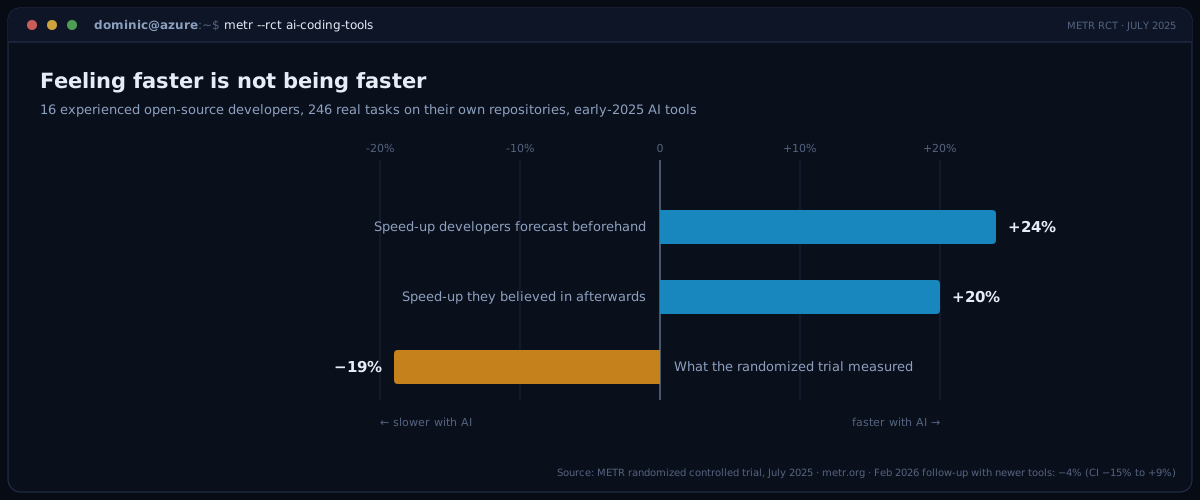
Coding is the beachhead. Tools like Claude Code, GitHub Copilot’s agent mode, and Cursor no longer autocomplete lines; they take an issue, explore a repository, write a patch, run the tests, and open a pull request. But the honest data point of the past year is a humbling one. In a randomized controlled trial, METR found that experienced open-source developers using early-2025 AI tools were 19 percent slower on their own mature codebases - while believing they had been sped up by 20 percent. A 2026 follow-up with newer tools and a larger cohort found the slowdown had shrunk to roughly zero, with the confidence interval spanning both sides. The lesson is not “agents can’t code.” It is that measured reality and perceived productivity can diverge wildly, and that gains are largest on unfamiliar code, boilerplate, and migration work - not on the code you already know by heart.
2. Cybersecurity - on both sides of the wall
Nowhere is the dual-use nature of agents clearer. On defense, Google’s Big Sleep agent found a previously unknown exploitable memory-safety bug in SQLite in 2024, and in July 2025 discovered a critical SQLite vulnerability (CVE-2025-6965) that threat actors were preparing to exploit - the first publicly reported case of an AI agent foiling an exploitation attempt in the wild. On offense, Anthropic reported in November 2025 that a Chinese state-sponsored group had manipulated its own coding agent into running most of an espionage campaign against roughly thirty organizations, with the AI executing an estimated 80 to 90 percent of the operation autonomously (the campaign is now catalogued by MITRE ATT&CK as C0062). AI agent security stopped being a thought experiment that month.
3. Scientific research
Google’s AI “co-scientist,” a multi-agent system announced in February 2025, generates and debates hypotheses; in a test with Imperial College London it independently proposed the same mechanism for bacterial gene transfer that the team had spent years establishing but had not yet published. DeepMind’s AlphaEvolve evolved an algorithm that beat a 56-year-old record for multiplying 4×4 complex matrices and recovered, on average, 0.7 percent of Google’s global compute through better scheduling. These are narrow, verifiable wins - not “AI does science,” but AI doing the searching, ranking, and grinding parts of science at a scale no lab can match.
4. Finance
Banks are the most instructive enterprise case because they are simultaneously aggressive and terrified. JPMorgan has rolled generative AI assistants out to hundreds of thousands of employees and says the next step is agents that handle multi-step workflows across systems - while conceding that long-running autonomous agents are not yet safe enough for corporate deployment (per the CNBC report above). Gartner expects 15 percent of day-to-day work decisions to be made autonomously by 2028, up from essentially zero in 2024. So far the pattern across Wall Street is augmentation - drafting, summarizing, reconciling - with humans still owning judgment and relationships.
5. Healthcare
Healthcare shows what bounded autonomy looks like. Fully autonomous AI diagnosis has existed in one narrow slice since the FDA cleared the first autonomous diabetic-retinopathy screener in 2018; ambient AI scribes that draft clinical notes are now deployed across major health systems; and the current agentic frontier is the paperwork nobody loves - prior authorization, claims appeals, care coordination. The clinical stakes explain the caution: this is the sector where “a wrong action” has a body attached, and where regulators (rightly) move slowest.
The risks, without the hand-waving
Security is the unsolved one. Agents read untrusted content - web pages, emails, documents - and a malicious instruction hidden in that content can hijack them. This is prompt injection, and unlike a software bug it has no clean patch, because interpreting instructions is the product. The dangerous combination is an agent with access to private data, exposure to untrusted content, and the ability to communicate outward. Strip away any one of the three and you remove most of the sting; grant all three and you have built the espionage campaign described above, just waiting for a customer.
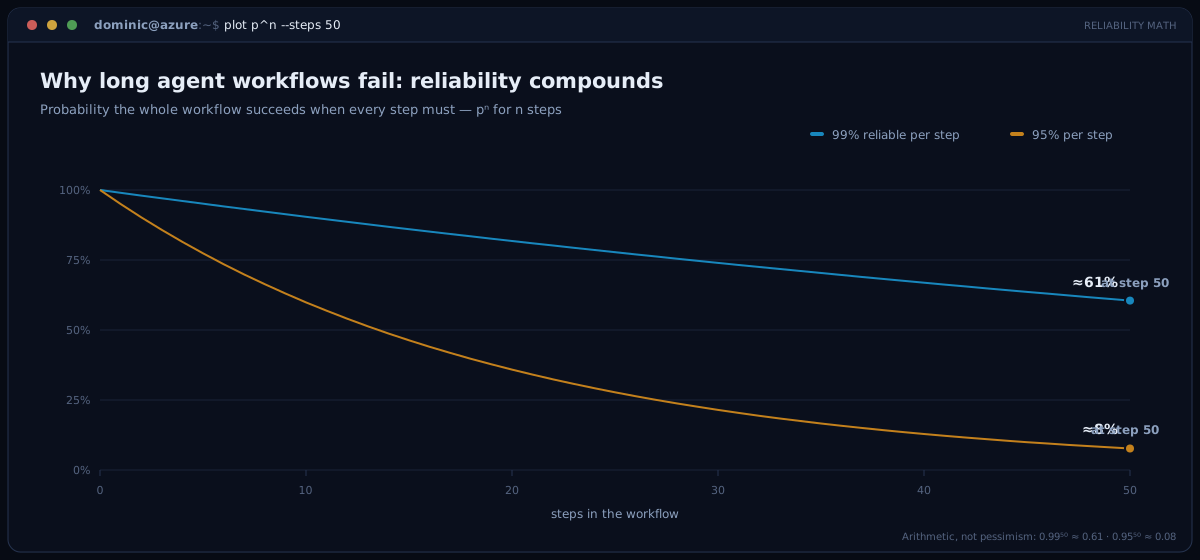
Reliability compounds. An agent that is 99 percent reliable per step succeeds about 60 percent of the time across a fifty-step workflow. That is arithmetic, not pessimism, and it is why “human-in-the-loop” is an architecture decision, not a compliance slogan. Add the METR perception gap - feeling 20 percent faster while being slower - and self-reported agent ROI deserves the skepticism you would apply to any other unmeasured claim.
Regulation arrived, then blinked. August 2026 was supposed to be the EU AI Act’s big deadline for high-risk systems. Weeks before it hit, the EU’s Digital Omnibus deferred those obligations to December 2027 and beyond, while transparency and AI-content-labeling duties did take effect on August 2. The signal for anyone deploying agents: the rules are coming, the timeline is political, and building governance now is cheaper than retrofitting it under a deadline.
Work is shifting at the entry level first. A Stanford Digital Economy Lab study of millions of payroll records (Canaries in the Coal Mine?, 2025) found employment for 22-to-25-year-olds in the most AI-exposed occupations down 13 percent relative to less-exposed peers, even as overall employment grew - and the lab’s August 2026 update puts that gap at 19 percent and still widening. The pattern to watch is not mass replacement; it is the quiet thinning of the tasks juniors used to learn on - which is a training-pipeline problem the industry has barely begun to face.
Add the mundane but decisive ones: agents inherit the biases of their models and then act on them; and long agentic workflows burn tokens at a rate that has sunk many a pilot before any of the above even mattered.
How to prepare, concretely
Learn to supervise, not just prompt. The valuable skill in 2026 is decomposing work into verifiable chunks, specifying acceptance criteria, and reviewing an agent’s output the way you would review a talented junior colleague’s: trust the effort, verify the claims. If you are technical, spend an afternoon wiring up an MCP server; the mechanics teach you more than any think-piece.
Experiment small, and measure. Gartner’s cancelled-project statistic is mostly a story of pilots that never defined a baseline. Pick one bounded, repetitive, low-blast-radius workflow. Measure how long it takes today. Then let an agent at it, and compare - actual numbers, not vibes, because the METR study shows vibes lie.
Governance before autonomy. Least-privilege credentials for every agent, sandboxed execution, complete action logs, and a human sign-off on anything irreversible or outward-facing. Assume prompt injection will be attempted. None of this is exotic; it is the same discipline we already apply to CI/CD pipelines and service accounts, applied to a new kind of actor.
Keep a verification habit. Thirty minutes a week with primary sources - the AI Index, METR’s evaluations, vendor security advisories, the actual text of regulations - beats hours of secondhand commentary. This field punishes people who outsource their epistemics.
The next 12 to 24 months
If the task-length curve holds, agents that reliably work a full day on a single goal arrive within this window. Expect the cancellation wave Gartner predicted to wash out the hype projects while the boring, measurable ones - back-office workflows, code migration, security triage, scientific search - quietly compound. Expect the EU’s December 2027 high-risk deadline to make agent governance a board topic rather than an engineering one. And expect at least one more incident like November’s espionage campaign, because the offense is automating too.
The future of work question, honestly stated: agents are becoming excellent at tasks while remaining unreliable at jobs - and most jobs are bundles of tasks plus judgment, context, and accountability. How that bundle gets renegotiated is the real story of the next two years, and it will be decided as much by deployment choices as by model capability.
So here is my question for you: which task would you hand to an agent tomorrow - and which one would you never delegate, no matter how good the models get? I would genuinely like to know; the comments are open. If this post was useful, share it with someone who is agent-curious, or subscribe to the feed to catch the follow-ups. And if you want the deeper backstory on the models underneath all this, my recent piece on forty years of tabular machine learning pairs well with it.
Sources and suggested references
- Stanford HAI, The 2026 AI Index Report - agent benchmarks and enterprise adoption data.
- METR, Measuring the Impact of Early-2025 AI on Experienced Open-Source Developer Productivity (2025) and Measuring AI Ability to Complete Long Software Tasks (2025).
- Gartner, press release on agentic AI project cancellations (June 2025) and on task-specific agents in enterprise apps (August 2025).
- Anthropic, Disrupting the first reported AI-orchestrated cyber espionage campaign (November 2025); see also MITRE ATT&CK campaign C0062.
- Google, security updates on the Big Sleep agent (2025); Google DeepMind, AlphaEvolve (2025); Google Research, Accelerating scientific breakthroughs with an AI co-scientist (2025).
- Brynjolfsson, Chandar & Chen, Canaries in the Coal Mine? Six Facts about the Recent Employment Effects of Artificial Intelligence, Stanford Digital Economy Lab (2025), and its August 2026 update.
- Gibson Dunn, EU AI Act Omnibus Agreement - Postponed High-Risk Deadlines and Other Key Changes (2026); CNBC, JPMorgan Chase to deploy more powerful AI agents this year (June 2026).
Comments
Sign in with your GitHub account to leave a comment or a reaction.