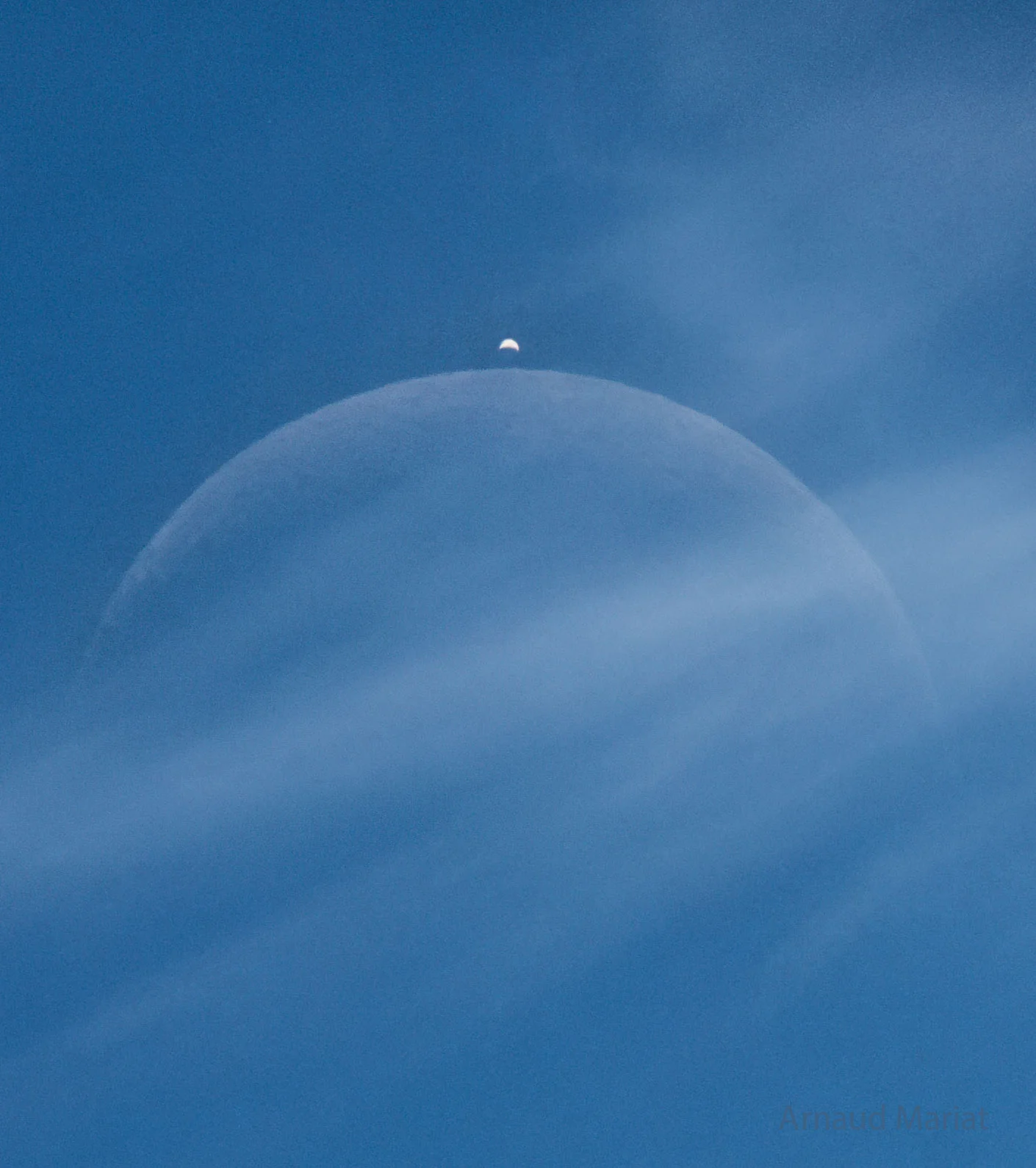
Each day, the NASA APOD archive turns a different corner of the cosmos into a brief, human-sized window on the universe. Today’s image, “A Daytime Eclipse: Moon Occults Venus”, is a reminder that even a single observation can carry a surprisingly long story.
Arnaud Mariat
There was something behind the clouds. Upon close inspection, it was the Moon, which was hard to see yesterday around noon above the small village of Cessy, France. But soon, it was not only the Moon. As expected, a bright dot suddenly appeared from behind the Moon – the planet Venus far in the distance. Captured in the single featured exposure, both appeared to show a crescent phase. The Moon’s crescent was quite slight – with only about 10 percent of its face illuminated by the Sun. In contrast, Venus’s crescent was more full – showing about 25 percent illumination. Venus appeared brighter because it is nearer the Sun and because its clouds are more reflective than the dark…
Why it caught my attention
This image stands out because it gives a compact view of a process or object that is easy to overlook when the sky is treated as a background. The science is not a dramatic narrative invented after the fact; it is the reason the observation matters in the first place: a structure, an event, or a field captured with enough clarity to reward a second look.
Source data: NASA APOD.
Comments
Sign in with your GitHub account to leave a comment or a reaction.