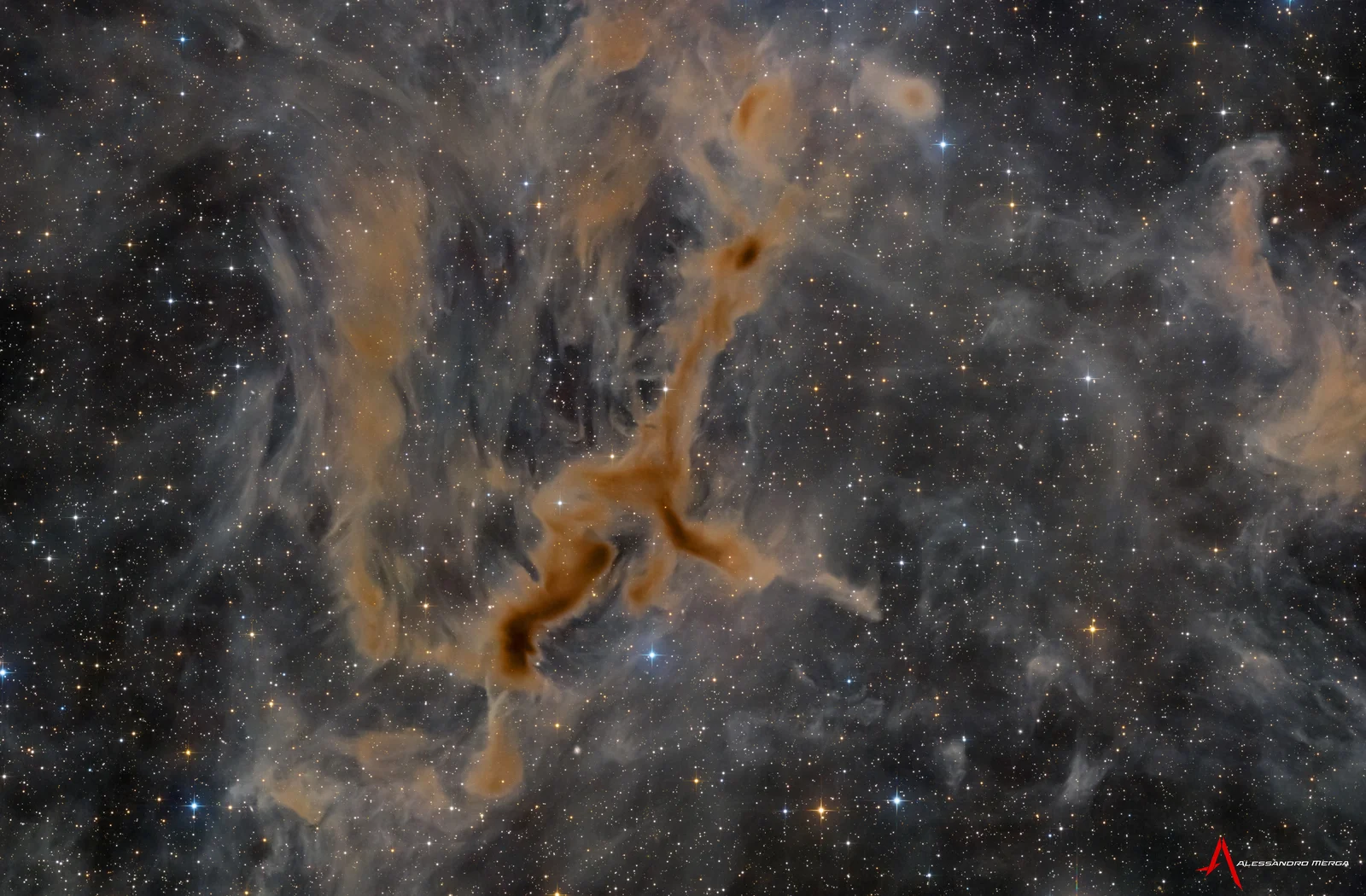
Each day, the NASA APOD archive turns a different corner of the cosmos into a brief, human-sized window on the universe. Today’s image, “LDN 1295: The Giraffe Nebula”, is a reminder that even a single observation can carry a surprisingly long story.
Alessandro Merga Text: Cecilia Chirenti (NASA GSFC, UMCP, CRESST II)
What does this image look like to you? Many see a giraffe facing right, with neck stretched high and long legs mid-stride (but some may see a squirrel instead). The featured image shows LDN 1295, also called the Giraffe Nebula, in the constellation of the mythical queen of Aethiopia (Cassiopeia). It is an object in the Lynds Catalogue of Dark Nebulas, compiled in 1962 by American astronomer Beverly Lynds, a pioneer for women in astronomy and astrophysics. Dark nebulas are interstellar clouds of dust and gas that block the visible light of the stars behind them. These nebulas are often faint and challenging targets for astrophotographers. Why do we see animal shapes and faces…
Why it caught my attention
This image stands out because it gives a compact view of a process or object that is easy to overlook when the sky is treated as a background. The science is not a dramatic narrative invented after the fact; it is the reason the observation matters in the first place: a structure, an event, or a field captured with enough clarity to reward a second look.
Source data: NASA APOD.
Comments
Sign in with your GitHub account to leave a comment or a reaction.