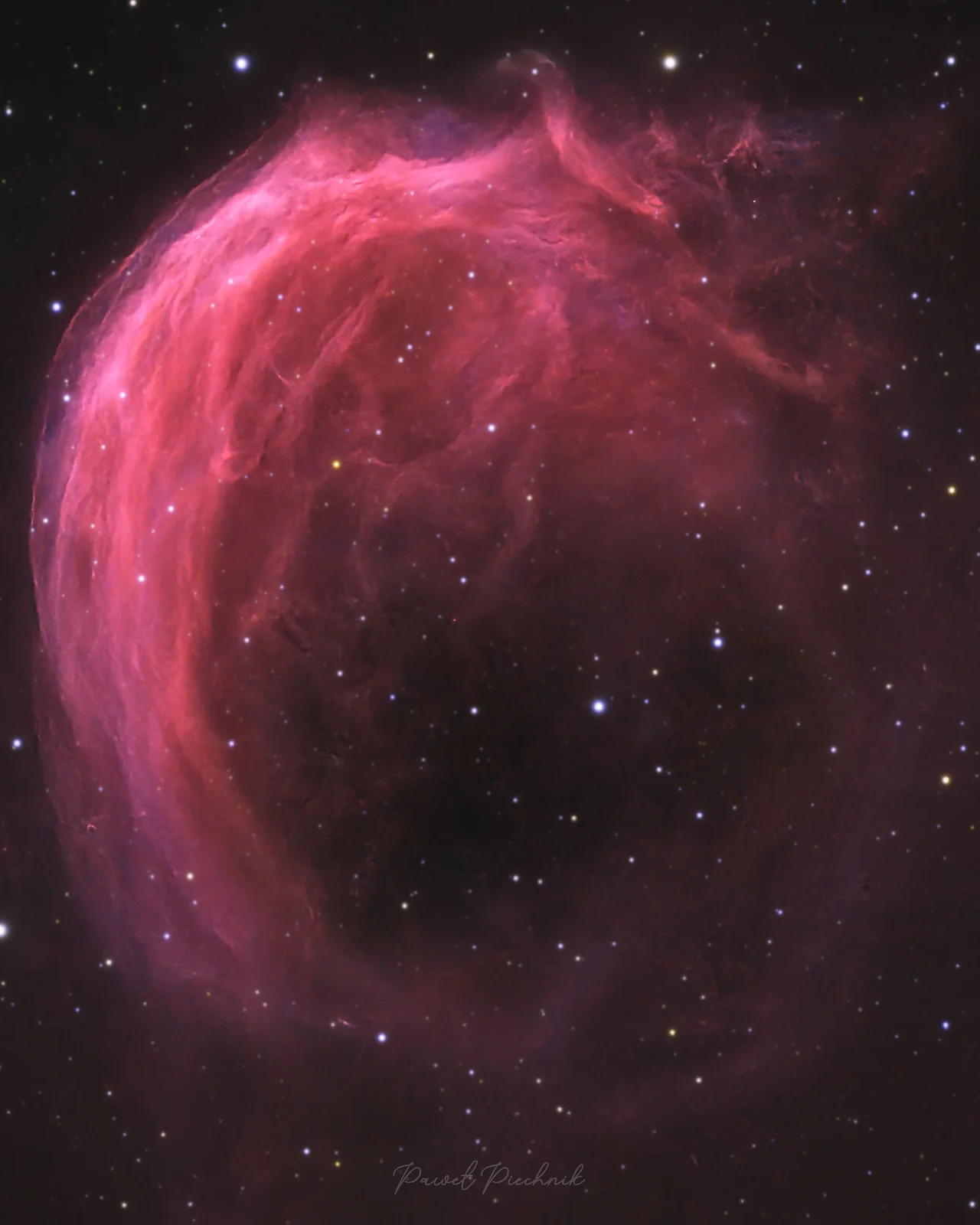
Each day, the NASA APOD archive turns a different corner of the cosmos into a brief, human-sized window on the universe. Today’s image, “Sh2-188: The Shrimp Nebula”, is a reminder that even a single observation can carry a surprisingly long story.
Pawel Piechnik
What causes the swirl in the Shrimp Nebula? Its high speed is likely. What is sure is that Sh2-188 is one of the larger planetary nebulas on the night sky, by angular size, spanning about half the diameter of the Moon. Moreover, the white-dwarf core – leftover from the Sun-like star that shed its outer atmosphere – is moving unusually fast through interstellar space, creating a bow shock most visible on the upper left that is similar to a boat plowing through water. Although faint, the Shrimp Nebula glows also by compressing and brightening gas on its leading edge. The featured image was taken in the light of hydrogen, sulfur, and oxygen by a backyard telescope in Krakow, Poland…
Why it caught my attention
This image stands out because it gives a compact view of a process or object that is easy to overlook when the sky is treated as a background. The science is not a dramatic narrative invented after the fact; it is the reason the observation matters in the first place: a structure, an event, or a field captured with enough clarity to reward a second look.
Source data: NASA APOD.
Comments
Sign in with your GitHub account to leave a comment or a reaction.