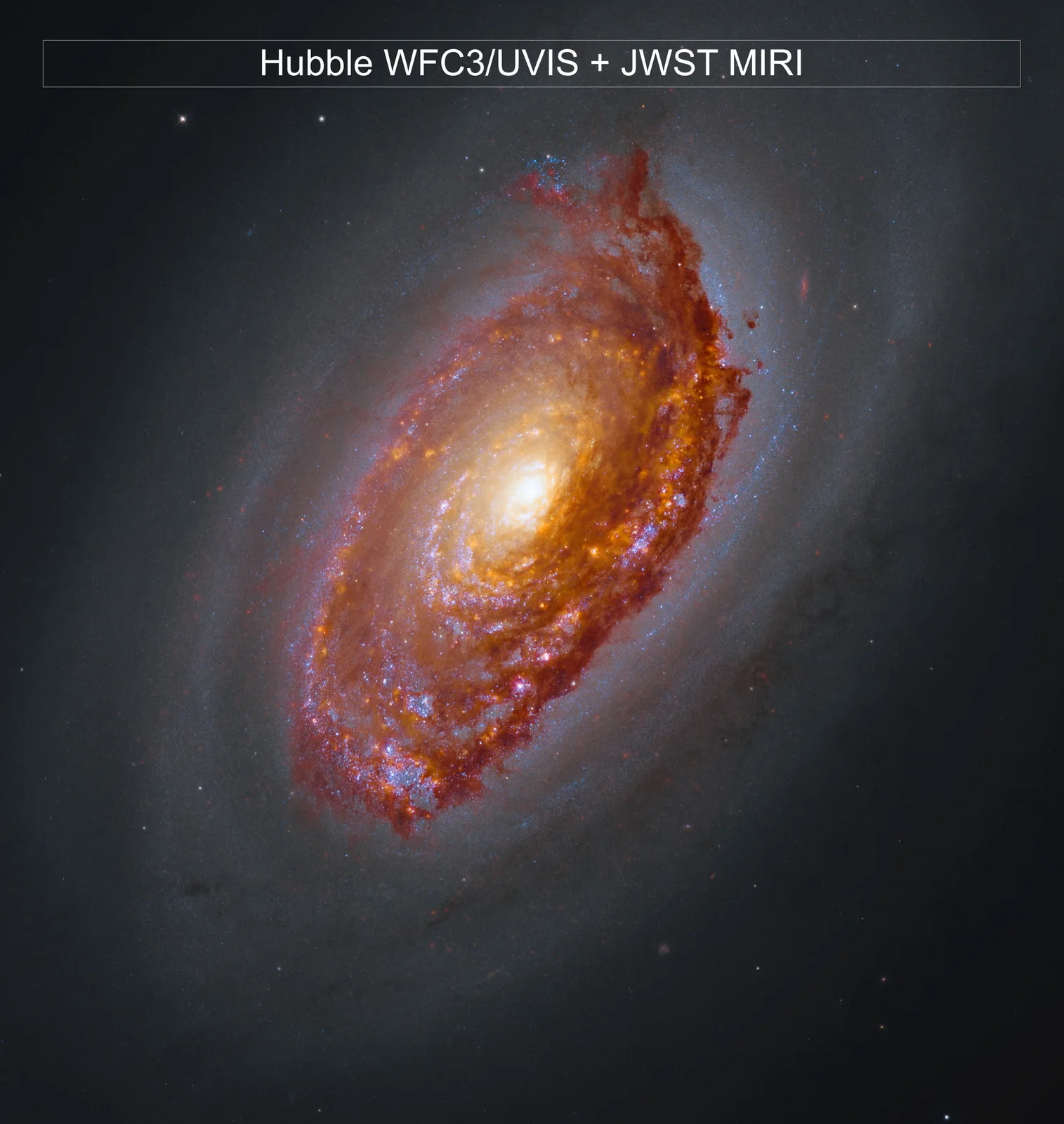
Each day, the NASA APOD archive turns a different corner of the cosmos into a brief, human-sized window on the universe. Today’s image, “Webb’s View of M64”, is a reminder that even a single observation can carry a surprisingly long story.
Credit: NASA APOD
Sometimes where Hubble finds darkness, Webb sees light. An example is today’s composite images of Messier 64 (M64), a nearby spiral galaxy of many names. The dark band of dust partially blocking its bright core earned it the moniker “the Black Eye Galaxy.” Webb’s Mid-InfraRed Instrument (MIRI) sees that dust, shown in red, as it absorbs and re-emits light from surrounding newborn stars. These young stars are embedded in pink star-forming regions in the secondary Hubble-only image. M64’s inner and outer gas regions counter-rotate, creating regions of increased star formation where the two gas “currents” meet and compress. A merger between M64 and a smaller galaxy was likely the cause of…
Why it caught my attention
This image stands out because it gives a compact view of a process or object that is easy to overlook when the sky is treated as a background. The science is not a dramatic narrative invented after the fact; it is the reason the observation matters in the first place: a structure, an event, or a field captured with enough clarity to reward a second look.
Source data: NASA APOD.
Comments
Sign in with your GitHub account to leave a comment or a reaction.