A single message rarely tells you a young person is in trouble. Twelve messages that get shorter, darker, and further apart do. That shift - from “instant risk in one message” to “drift across a whole conversation” - is the idea behind CEDD (Conversational Emotional Drift Detection), the second system our team 404HarmNotFound built at the March 2026 AI safety hackathon organized by Mila with Bell and Kids Help Phone.
Where our bilingual input guardrail classifies each conversation snapshot as low_risk or high_risk before it reaches the LLM, CEDD is the orthogonal layer: it monitors the trajectory of the user’s messages in real time - length, tone, semantic drift, behavioral withdrawal - and adapts the chatbot’s behavior as the conversation degrades, from warm support all the way to a crisis protocol with a warm handoff to a human.
The problem: gradual deterioration is invisible to per-message classifiers
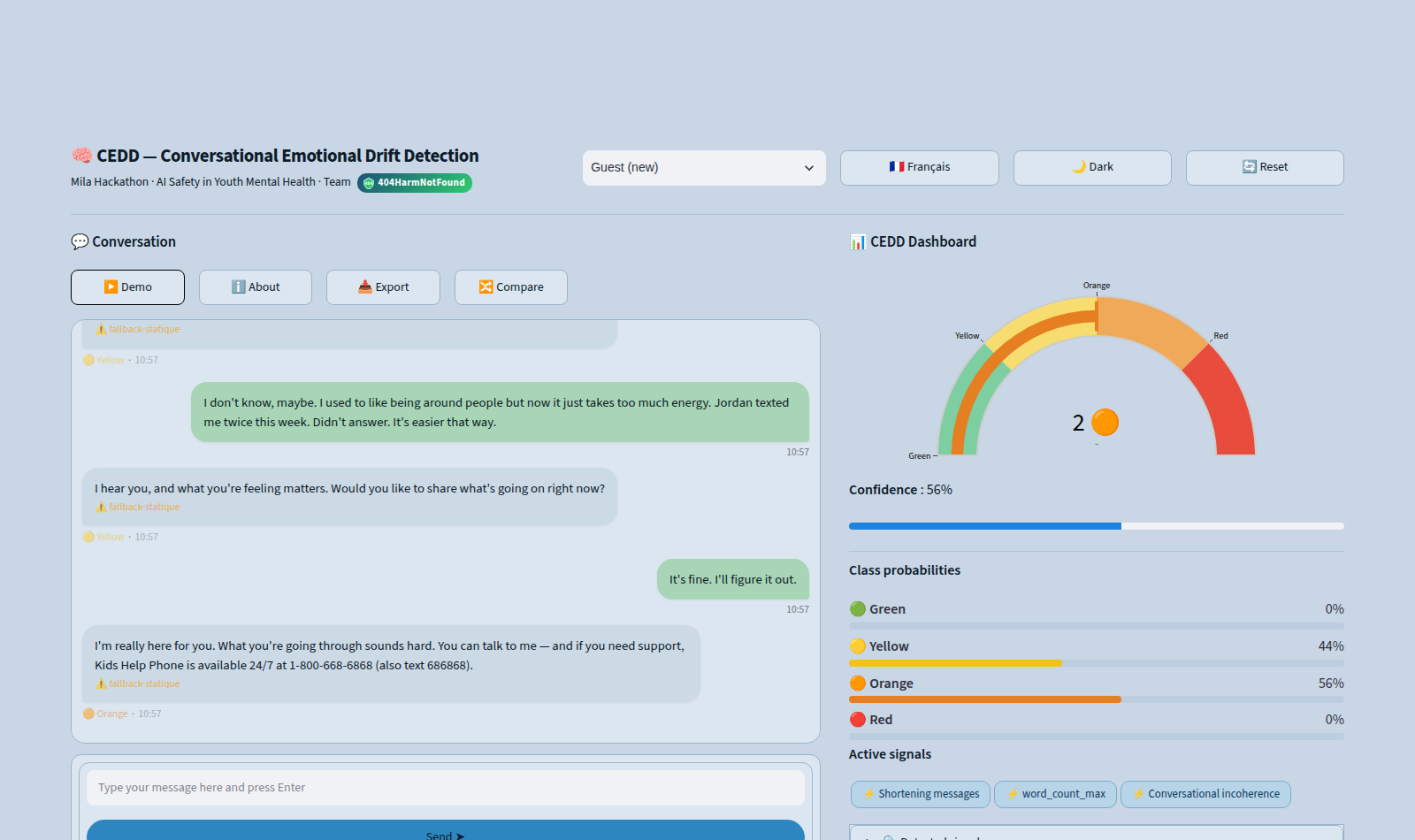
Emotional support chatbots for youth (the target population here is 16-22) can miss a slow slide into distress: no single message contains a crisis keyword, yet the conversation as a whole is unmistakably drifting. The signals are behavioral as much as lexical - messages getting shorter, hope vocabulary disappearing, topics being avoided, replies coming slower. CEDD turns that intuition into a feature space.
The architecture: 67 trajectory features, ML behind safety gates
flowchart TD
    A["User messages (FR / EN / mixed)"] --> B["Feature Extractor<br/>10 lexical features per message<br/>+ embeddings + coherence → 67D vector"]
    B --> C["CEDDClassifier<br/>GradientBoosting + 7 safety gates"]
    C --> D["Alert level 0-3 + confidence<br/>+ top-5 explanatory features"]
    D --> E["Response Modulator<br/>adaptive system prompt (FR / EN)"]
    E --> F["LLM chain with fallback<br/>Cohere → Groq → Gemini → Claude → static"]
    D --> G["Session Tracker<br/>SQLite longitudinal history"]
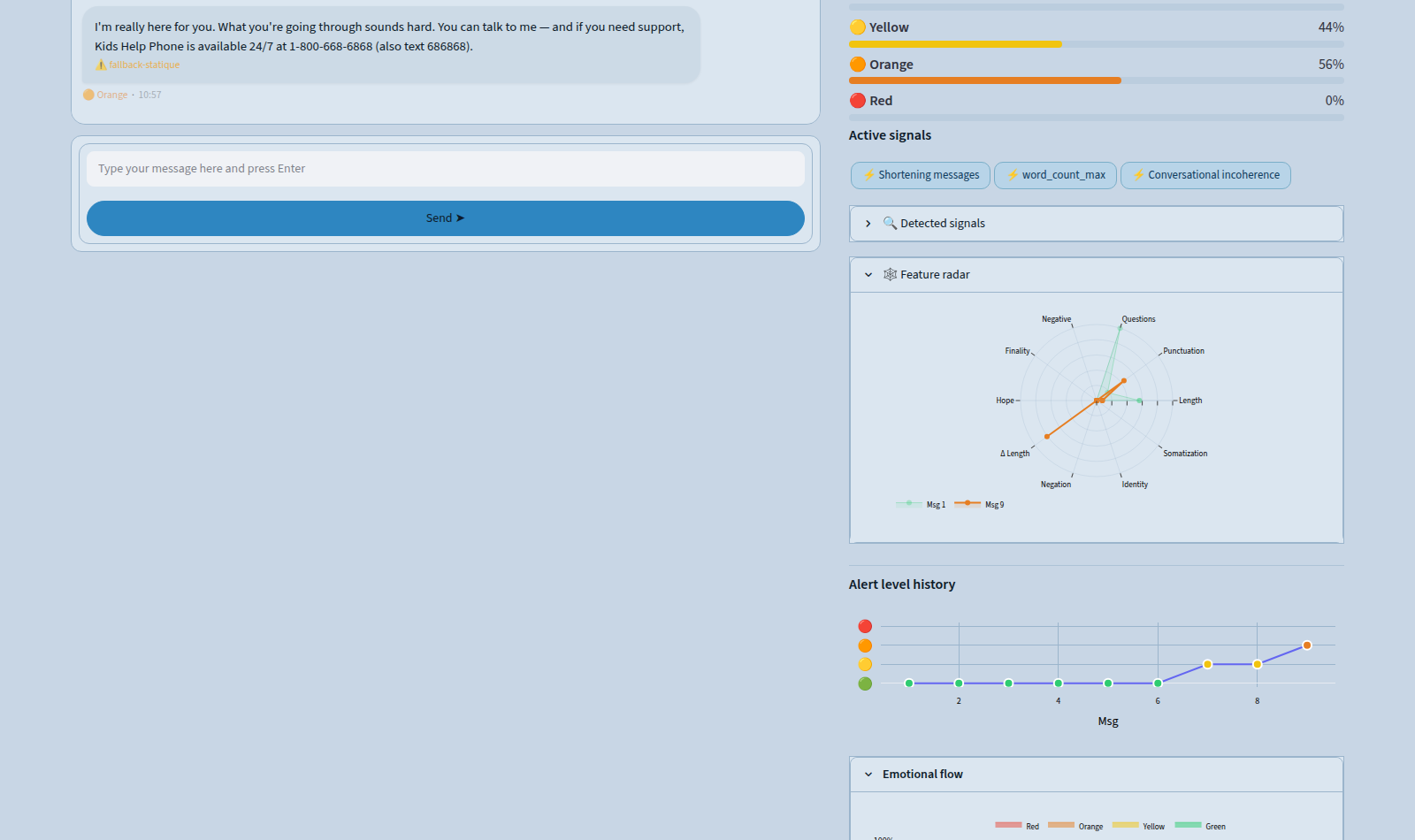
Feature extraction. Each user message yields 10 interpretable features - word count, punctuation ratio, negativity, finality vocabulary, hope vocabulary, negated positive states (“je ne me sens pas bien”, “can’t cope”), identity-conflict signals, somatization, and length dynamics - computed against fully bilingual FR/EN lexicons. For each feature, six trajectory statistics (mean, std, slope, last, max, min) capture the trend over the conversation: 60 features. Four more come from multilingual sentence embeddings (paraphrase-multilingual-MiniLM-L12-v2): semantic drift between consecutive messages, similarity of the last message to a crisis-language centroid, directional drift via PCA, and overall variance. Three conversational-coherence features (short-response ratio, minimum topic coherence, question-response ratio) capture behavioral withdrawal. Total: 67 features, all explainable.
Classification with a safety-first contract. A StandardScaler → GradientBoostingClassifier pipeline maps the 67D vector to one of four alert levels - Green, Yellow, Orange, Red. But the ML never has the last word: 7 safety gates wrap it. Crisis keywords force Red instantly at any point; low ML confidence defaults to Yellow (precautionary principle); short conversations cap the ML at Orange; a lexical safety floor guarantees the prediction can never go below what keyword rules detected; and long response delays bump the level up. The design rule we kept from the guardrail project applies here too: safety rules can never be overridden by ML.
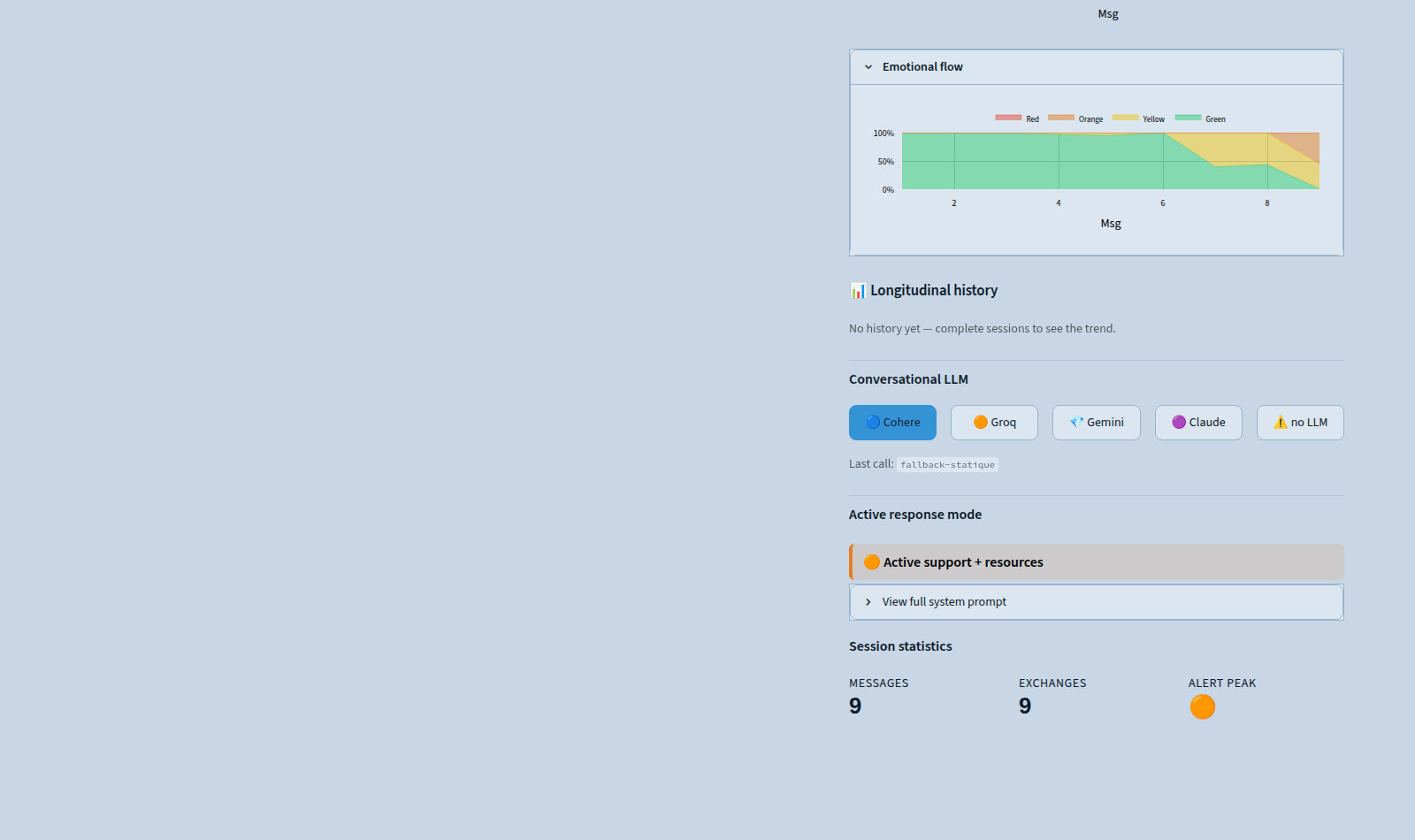
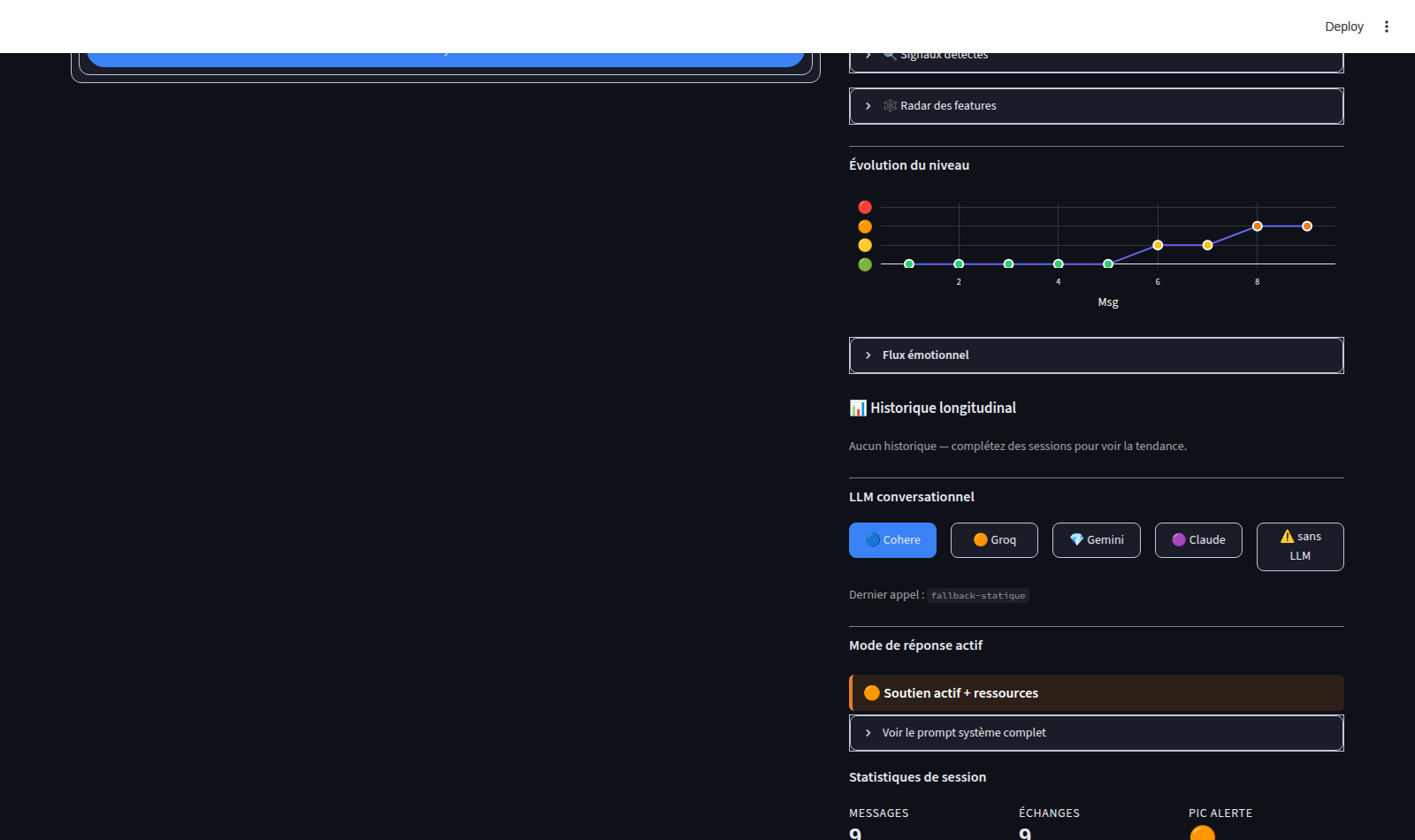
Adaptive response modulation. The alert level selects one of four system prompts (in the user’s language) injected into the conversational LLM: standard warmth at Green, enhanced emotional validation at Yellow, active support with resources at Orange, and at Red a 5-step warm handoff - empathetic validation, permission-based transition, resources (Kids Help Phone 1-800-668-6868, text 686868, 9-8-8, 911), encouragement to connect, continued presence - plus an optional switch to “Alex”, a simulated counselor persona using ASIST active-listening techniques. The LLM layer itself is resilient: a fallback chain (Cohere → Llama 3.3 70B via Groq → Gemini 2.5 Flash → Claude Haiku → static text) with per-model timeouts, so the UI never freezes on a slow provider.
Longitudinal tracking. A SQLite session tracker follows users across sessions: weighted risk score over the last 7 sessions, improving/stable/worsening trend, consecutive high-alert sessions, and withdrawal detection when a user disappears for more than 24 hours after a session without closure.
The data: 600 synthetic bilingual conversations, adversarial by design
With no real clinical data available, we generated 600 labeled conversations (~24 messages each) via the Claude API in authentic Canadian French and English: 480 standard conversations across the four alert archetypes, plus 120 adversarial ones designed to break naive classifiers - pure physical complaints that must stay Green, dark humour masking isolation, reveal-minimize-reveal deflection patterns, 2SLGBTQ+ identity distress, neurodivergent flat affect, and crisis language followed by “I’m fine” (which must stay Red).
Results
| Metric | Value |
|---|---|
| Cross-validation accuracy (k=4) | 90.0% ± 1.6% |
| Features | 67 (10×6 trajectory + 4 embedding + 3 coherence) |
| Training conversations | 600 (480 standard + 120 adversarial) |
| Adversarial tests | 36/36 passing (20 categories) |
| Unit + integration tests | 133/133 passing (pytest) |
| Critical misses (crisis predicted Green/Yellow) | 0 |
The adversarial suite is the part I would defend in front of a clinician: 36 hand-built scenarios across 20 categories - Quebec slang (“chu pu capable”), code-switching, sarcasm, negation, sudden escalation, rapid-recovery manipulation, cultural false positives (“mort de rire”, “killed it”), neutral uses of “personne” - with a dedicated exit code that treats any missed crisis as a merge-blocking regression. The baseline started at 7/10 on the first version; nine iterations of features, lexicon fixes, and word-boundary regex work brought it to 36/36 with zero critical misses, while CV accuracy stayed stable around 90%.
Lessons learned
Trajectory beats snapshot for slow drift. The top features by importance are all trajectory statistics (word_count_max, word_count_slope, word_count_last): how the messages evolve matters more than what any single message says. That validated the core hypothesis of the project.
Explainability is a safety feature. Every alert ships with its top-5 contributing features (model importance × scaled value), displayed as a bar chart in the bilingual Streamlit dashboard. In a mental-health context, “the system raised an alert because messages shortened 60% and finality vocabulary appeared” is actionable for a counselor; a bare probability is not.
Document your failure modes. The known-gaps table is part of the deliverable: conjugated crisis forms (“killing myself” vs “kill myself”) that slip past the keyword gate, phrase-based identity detection, threshold-based withdrawal detection. In safety work, an honest limitation list is worth more than an inflated metric.
Comments
Sign in with your GitHub account to leave a comment or a reaction.